

By Jason Beddow, Managing Director, and Meredith Hemsley, Head of Communications & Investor Relations, Argo Investments (ASX code: ARG).
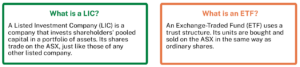
Exchange-traded funds (ETFs) have surged in popularity in recent years and are now a ubiquitous feature of our investment landscape. But how many investors understand how they stack up against listed investment companies (LICs), which have been a fixture on Australia’s share market for over 100 years?
ETFs and LICs do share some features. Both are bought and sold on the Australian Securities Exchange (ASX), offering investors easy access to a diversified portfolio of assets, often shares, with a small minimum investment. Beyond this, the mechanics of each structure diverge in ways that can lead to quite different outcomes and experiences.
A side-by-side comparison
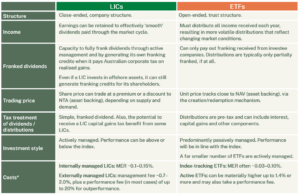
*The only direct costs associated with buying and selling LICs and ETFs are the fees paid to the broker (traditional or online), called brokerage. Management and performance fees are deducted from the LIC or ETF’s assets over time.
Two types of LICs: internally managed and externally managed
Internally managed LICs: These include many large, long-established LICs and typically take a long-term, low-turnover approach. Examples include AFIC and Argo Investments. The LIC is both the vehicle and the manager. These LICs employ their own investment teams and other staff. No fees are paid to an external manager. As a result, they have low MERs (~0.1–0.2%).
Externally managed LICs: The majority of LICs, those commonly listed since the early 2000s. They have an outside fund manager and pay a management fee (typically 0.7–2.0%) plus performance fees. Often for more active, specialist, or niche strategies (including international and private equity).
This distinction is important for investors to consider when it comes to alignment of interests, fees or costs, investment behaviour and returns over time. For more details, read our earlier article Understanding LICs: internally versus externally managed.
Structure: key to differences
Most key differences between a LIC and an ETF are attributable to their different structures: a LIC is a closed-ended company, while an ETF is an open-ended trust. Even if the underlying assets are the same, each structure gives rise to variations in costs, income and taxation treatment. It also impacts their trading price relative to their underlying assets.
Trading price
LICs: Broadly speaking, a LIC has a fixed number of shares on issue. The pool of capital managed by the LIC does not fluctuate based on shareholders’ money moving in and out. For the investment manager, it creates a stable pool of capital, so they are not forced to buy and sell investments to accommodate inflows and outflows.
Because a LIC’s shares simply change hands between buyers and sellers on the ASX, its share price is set by ordinary supply-and-demand mechanisms. As a result, its shares can trade above (a premium) or below (a discount) its net tangible assets (NTA) backing per share.
ETFs: In contrast, an ETF is open-ended, meaning its units are created and redeemed (cancelled) by market makers each day in response to investor demand.
An ETF’s creation/redemption mechanism effectively eliminates the gap between the unit price and the ETF’s net asset value per unit, so the two track each other closely. That said, they are not identical. The price to buy an ETF unit is higher than the price to sell it. This buy-sell spread reflects the transaction costs to trade the underlying assets.
Next article
Part II of this article will look at the impacts of each structure on income and franking and taxation implications in more detail.