

By Jason Beddow, Managing Director, and Meredith Hemsley, Head of Communications & Investor Relations, Argo Investments (ASX code: ARG).
Our previous article outlined the main differences between LICs and ETFs and how their structures give rise to many of those distinctions. Here we examine some of the more practical outcomes of these differences for investors.
Income
LICs: Since a LIC can accumulate earnings from multiple periods in retained earnings or a profit reserve, it can access those reserves to distribute dividends during weaker years. This allows a LIC to effectively smooth dividend payments over a market cycle, offering shareholders more consistent income.
ETFs: An ETF’s trust structure requires it to distribute the income it receives from its underlying investments each year to its investors. As a result, ETF income can be volatile, rising and falling with the market.
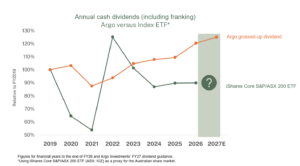
This was aptly demonstrated during the COVID crisis, when many Australian companies substantially cut their dividends (and franking levels) or cancelled them altogether. This meant the market’s aggregate dividend (and therefore Australian index-tracking ETFs) fell sharply. Meanwhile, many LICs drew on reserves and maintained, or only modestly cut, their dividends during the same period. After the crisis, companies restored, or even increased, their payouts, and the Australian share market’s overall dividend rebounded. However, importantly, most LICs had been able to smooth the sharp dip in dividend income.
This can be illustrated by comparing the grossed-up yield paid by Argo Investments to the iShares 200 ETF between 2020 and 2025 as per the chart below.
Franking
LICs: A LIC is an Australian corporate taxpayer. So, when it realises gains on investments in its portfolio and pays corporate tax, it generates imputation (franking) credits, even on overseas assets. Additionally, a LIC can receive franking credits with dividends received from its portfolio of investments if those investments paid Australian corporate tax. A LIC can accumulate and distribute these franking credits, enabling it to fully frank its dividends.
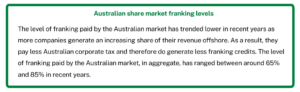
ETFs: As trusts, ETFs do not pay corporate tax. Franking passes through to investors only to the extent it is received from the underlying holdings and is typically materially less than 100%. The level of franking paid by ETFs will likely vary from year to year, depending on what the companies in their portfolios distribute.
Tax treatment of dividends and distributions
LICs: Shareholders receive a single dividend, that is typically fully franked, with no other sources of taxable income. Capital gains crystallise only when the shareholder chooses to sell their shares.
A handful of older, long-term, buy-and-hold LICs can also pass on a special LIC capital gains tax discount that Australian taxpayers can use as a tax deduction, in addition to the benefit of franking.
ETFs: Investors receive pre-tax distributions that can include several types of income, such as interest, foreign income and realised capital gains, with pass-through tax obligations for the investor. This can obscure ultimate returns and make tax time more administratively complex. Investors also have less control over when capital gains are realised, since that decision sits with the fund, not the investor.
In summary
LICs and ETFs both offer diversified, ASX-tradeable exposure to a portfolio of assets. However, the investor experience and outcomes can differ meaningfully because of the different structures of these investment vehicles: a closed-ended company versus an open-ended trust. That single difference affects a range of factors, including pricing, income, franking and tax treatment.
Understanding these differences can help investors determine which structure suits them best.