


By Stephanie Stefanovic, Content Manager at Sharesight
For decades, investing has remained a stubbornly male space. From brokerage accounts to financial media, the industry has historically been shaped by and aimed at men. New data from portfolio tracker Sharesight suggests Australia is moving in a noticeably different direction, with women now making up a meaningfully larger share of its Australian user base than in any other comparable Western market.
The numbers
An analysis of anonymised data from hundreds of thousands of Sharesight users worldwide shows that women make up 24.1% of Australian users on the platform, more than double the proportion seen in the United States (9.9%) and the United Kingdom (9.6%), and well ahead of Canada (11.7%) and New Zealand (17.9%).
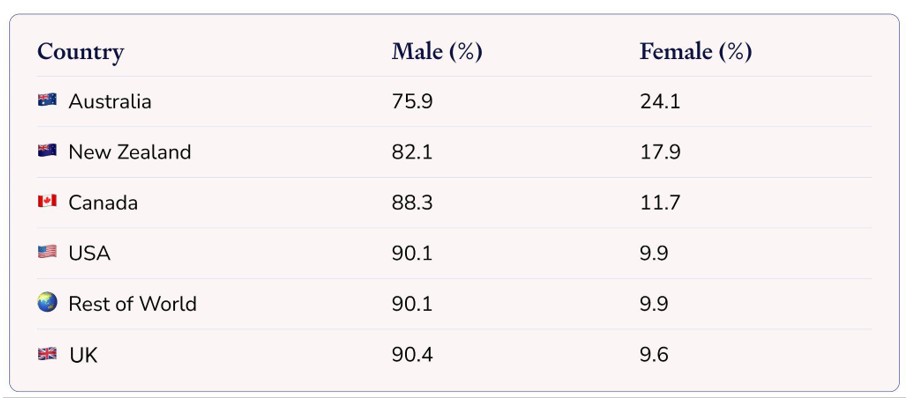
Source: Sharesight user data
It is worth a caveat here: Sharesight’s user base is opt-in and not nationally representative, so these figures reflect who is actively using the platform to track their investments rather than the total investing population in each country. Even with that qualifier in mind, the size of the gap between Australia and every comparable market is difficult to dismiss.
“Although this doesn’t necessarily reflect overall national participation rates, the data suggests Australian women may be more engaged in actively tracking and managing their investments than their peers in other Western markets,” says Jessica Goodall, Chief Customer Officer at Sharesight.
What’s driving the difference?
There is no single explanation for the difference, but a handful of structural and cultural factors stand out, and together they offer a fairly compelling picture of why Australia has pulled ahead.
The first factor is superannuation. Australia’s compulsory super system turns every working person into an investor from their first payslip, regardless of gender, with no opt-in moment and no decision to engage required. That sets up a meaningful contrast with the UK and US, where workplace pensions are often opt-out and many people never look closely at where their retirement money is invested.
“Compulsory superannuation means women are investors by default from the moment they enter the workforce,” says Shani Jayamanne, Director and Investment Specialist at Morningstar.
The second factor is the popularity of ETFs and passive investing in Australia, where public familiarity with index-based strategies is widespread and the perceived complexity of getting started has dropped accordingly. When investing feels accessible rather than intimidating, more people engage with it, including plenty of women who might otherwise feel that the industry is not speaking to them.
The third is a broader cultural shift, with discussions about financial independence and wealth equality for women now firmly in the Australian mainstream. Workplaces, media and everyday conversations have all caught up, and that shift quietly changes who feels welcome and capable in investing spaces.
The household CFO
The statistics tell only part of the story, and the rest is arguably about lived experience.
“Many women are already the CFO of their household — from managing day-to-day budgets to planning for the future,” says Dora Yip, Chief Marketing Officer at Pocketsmith. “It’s no surprise that investing is a natural extension of that role. The stereotype that women aren’t good investors is just one of many outdated myths about women and money.”
This is a fair point. The skills behind active portfolio tracking, including attention to detail, long-term thinking and regular review, are the same skills many women already apply to household finances every day, which makes the leap from one to the other much smaller than the traditional gender investment gap might suggest.
Engagement is the next step
For all the encouraging signs in the Australian data, men still make up roughly three-quarters of Sharesight’s Australian user base, so the gap has not closed so much as narrowed. The narrowing itself matters, however, because it is evidence that participation levels are not fixed, and that structural, cultural and product factors can genuinely make a measurable difference.
According to Jayamanne, this is also where the next opportunity sits.
“Automatic enrolment and participation don’t solve the well-documented retirement savings gap,” she notes. “Engagement — actively tracking and understanding portfolio holdings — is the critical next step. The women who engage with portfolio monitoring tools will make more informed portfolio decisions and strategies that can help with closing retirement savings gaps and lead to better quality of life.”
In other words, getting people into the system is the easy part, and helping them understand and manage what they are invested in is where the real progress happens.
A broader investing community
For platforms like Sharesight, the data is a reminder that the investing community is broader, more diverse and more engaged than traditional narratives suggest, and that there is still meaningful ground to cover everywhere, including at home in Australia.
The direction of travel, however, is clear. More Australian women than ever are tracking their portfolios, taking an active interest in their financial future and challenging the assumption that investing belongs to someone else. The next stage is less about getting them through the door than about making sure they have the tools, the information and the confidence to keep building from there.
Sharesight is a portfolio tracking software that allows investors to track their performance and tax, and provides the advanced insights they need to make better investing decisions. For more information visit sharesight.com